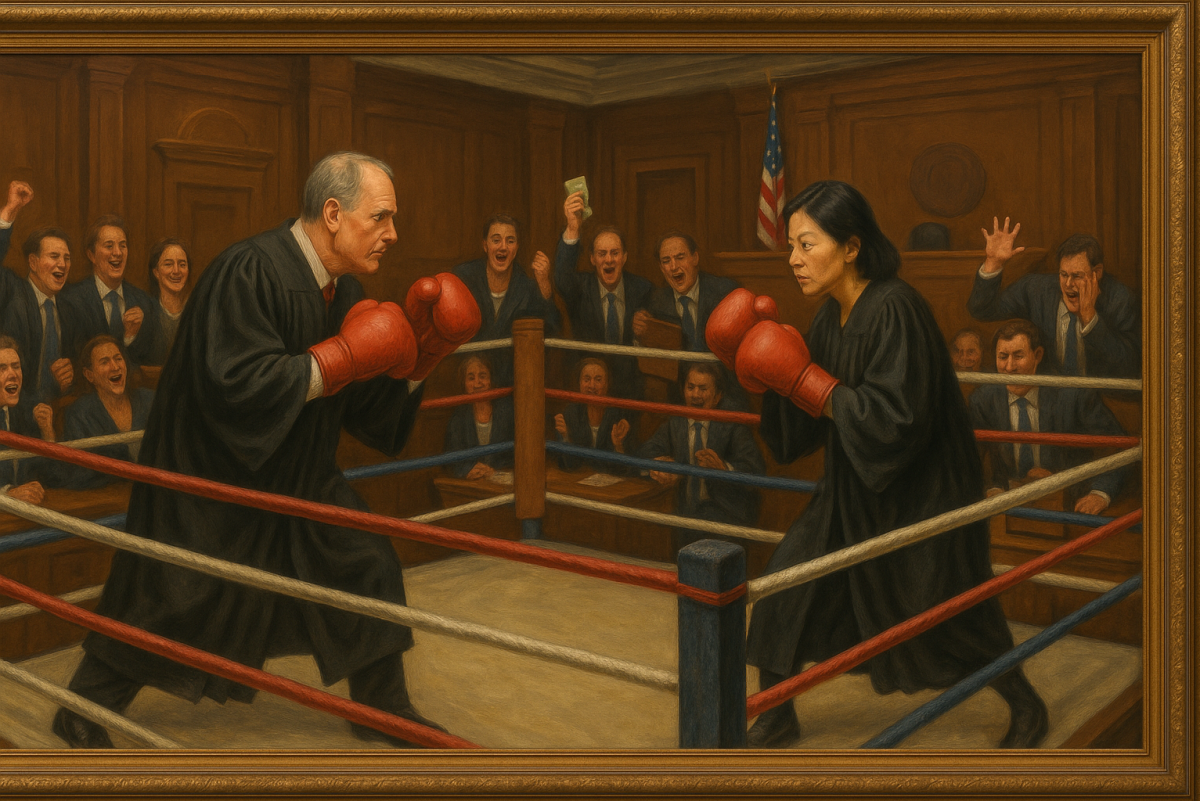
Debate me or it’s not core speech

I missed this abomination from Judge Crytzer in Shirinian v. Plowman (E.D. Tenn.):

Shirinian, a pre-tenure anthro prof at University of Tennessee, was suspended for a Facebook post saying the world was better off without Charlie Kirk and referring to him and his wife as “disgusting psychopath[s].” She was placed on administrative leave pending termination. Crytzer denied a TRO reinstating Shirinian pending litigation.

Contra the Ninth Circuit, Crytzer performed the Pickering balance as if Shirinian was not an academic, as if academic freedom principles do not inform that balance, and as if a university were an ordinary workplace environment undermined by contentious speech (rather than being a forum for just that speech, at least from faculty speaking on matters of public concern).

Worse, the court failed to give full weight to the speech side of the balance because while Shirinian’s speech was in a political “context,” the “general content” was not political because she “did not specifically engaged with Charlie Kirk’s politics or his political message.” This is peak “debate me” as the First Amendment’s be-all/end-all and it reflects utter ignorance of free speech. No more “vehement, caustic, and sometimes unpleasantly sharp attacks” on political figures; speech must debate and engage with ideas to stand at the core of free speech. Someone should introduce Judge Crytzer to Ardith McPherson or Paul Robert Cohen.

Or maybe Glenn Reynolds, who was investigated (unfortunately) but not sanctioned (properly) for a post saying “run them down” in reference to protesters blocking highways.

Happy New Year

As we enter our 22d year, I want to thank this group of bloggers for continuing this enterprise and our readers who followed us to our new online home.

I hope we can continue this game for another two decades.

I will be back tomorrow commenting on another year-end report from the Chief.

On the Kennedy Center cancellations

The artists refuse to perform at the Kennedy Center because of its connection to Trump and Trump cronies such as Ric Grenell and the political message they send through their management of and messaging through the center (not only in naming it for Trump). They have not refused to perform for particular audiences. Nor are patrons unable to see these artists at other venues, in and out of D.C. They have not even refused to perform for Trump Administration minions, who can buy tickets at those other venues.

Thus, Grenell’s suggestion that these artists are failing in their mission to bring the arts to the public is nonsense. But it represents the apotheosis of MAGA thought:

• Conflating Trump with the country. Artists not wanting to do business with Trump, Grenell, and other authoritarian threats are failing to engage with and perform for The People.

• Defining free speech (and “free speech culture”) as complete freedom, with no pushback, for MAGA speech, speakers, and listeners. This controversy moves the ball from “We can say what we want and any criticism or protest by you constitutes censorship” to “You must utter our preferred views” to “You must perform for us when and where we wish to hear you.” Telling, but not surprising, that we land here.

• Rejecting the idea that any non-MAGA person can have (or act on) sincere moral, political, conscientious, or ideological beliefs. A baker or web designer possesses an inalienable right to deny service to a gay couple because they object to what the couple wishes to do. and should not be criticized for that refusal. But a jazz musician lacks a similar right not to perform for a Trump-affiliated venue. Or, in doing so, the musician acts as an improper “partisan,” rather than on sincere conscience.

This will resolve as a contract issue–and I know neither the details of the contract nor anything about contract law to opine on it. I doubt the damages will run to $ 1 million, as Grenell announced to the world in truly Trumpian style. But I hear Contracts profs writing their final exams as we speak.

“This Guy is So Dangerous and Crazy, He Even Believes *Us*”

A headline in yesterday’s POLITICO piece about the accused January 6th pipe bomber nicely illustrates the challenges involved in covering, not to mention prosecuting, the case. The headline reads: “Justice Department says Jan. 6 pipe bomb suspect believed election conspiracy theories.”

A seemingly unexceptional headline, apart from the wild nature of the alleged facts of the case. Unexceptional, that is, until one remembers that “election conspiracy theories” are official regime policy. The premise that the 2020 election was “stolen” in a wide-ranging public-private conspiracy is neither lunacy nor speculation, according to this regime. It’s orthodoxy. It is axiomatic: treated as authoritatively true by the executive branch–and, by the regime’s own self-understanding, ultimately by anyone who still works in the executive branch.

This is not simply a matter of casual offhand assertions about the election by Donald Trump himself. We are well used to such remarks being tweeted out in the electronic glow that pierces the darkness of Mar-a-Lago from 10 p.m.-3 a.m. each night, like a sort of rheumy Eye of Sauron. Such statements, one might say, fall within the category of “things that ostensibly or formerly serious commentators, public officials, academics, ‘influencers,’ and ‘intellectuals’ who are still Trump apologists believe they should probably ignore and certainly aren’t obliged to address, unless they mention Rob Reiner.”*

Of course those statements should be taken seriously and, especially in a personalist regime that conflates a unitary executive structure with the very different question of the obligations of subordinate executive branch officials, it’s derelict to ignore them. But Trump’s delusions about 2020 are also the stuff of official executive branch documents. They serve as the basis not just for tweets, but for legally consequential actions against others. Most formally and prominently, there was the April “Get Krebs” memorandum, in which Trump directed his underlings to investigate and take action against Christopher Krebs, who committed the crime of administering-while-honest during the first Trump term. Krebs’s “misconduct,” that presidential memorandum says, included “falsely and baselessly den[ying] that the 2020 election was rigged and stolen.”

Then there is the ongoing grand jury investigation being conducted by US Attorney, poor-performance-review star, and ironic panelist Jason Reding Quiñones. He appears to be taking the approach advocated by his patron, the lawyer/grifter, 2020 fantasist, and internet troll Mike Davis: to avoid statute of limitations problems concerning the 2017 intelligence assessment by tying it into a “much longer conspiracy by federal officials to take away Trump’s rights,” including the 2020 election. It’s difficult to know more about the scope of that investigation yet, partly because of grand jury secrecy rules but mostly because the regime’s press operations are a cesspool of flagrant dishonesty. But certainly that is how the president understands the investigation. And of course one should recall that election denialists in positions of ostensible authority in the regime who have pledged to punish people on that basis include the FBI director; the de jure Attorney General; beacon of dignity, yawner-at-antisemitism, and DOJ Civil Rights Division chief Harmeet Dhillon; and whatever you want to call Ed Martin.

Maybe we could also spare a moment to remember that Heritage Foundation president Kevin Roberts made it crystal clear long ago that he is more than happy to treat the 2020 election as stolen, if you want him to and the money’s right. I was genuinely glad that further resignations from Heritage occurred last week; I’m more than happy to give credit where it’s due and hope that those who did so will live up to the moral logic of their resignations, which is hardly limited either to Heritage or to antisemitism. But Heritage had jettisoned the word “think” from the title “think tank” and substituted “in the” long before last month. Current presidential candidate J.D. Vance–whose views, statements, and patrons clearly foreclose any principled support from the Heritage resignees–has likewise taken the girlfriend-experience approach to 2020 election conspiracy claims; if it will please the client, he’s happy to pretend anything you want.

It will be interesting watching the DOJ finesse the status of the 2020 election as it proceeds to prosecute this case. It will have to advance the theory that the defendant was motivated to commit his alleged crimes on the basis of a shadowy-conspiracy theory. But it will also have to downplay the fact that the chief executive apparently believes it himself; that the grifters who curried favor with him all the way into high appointed office at least pretend to believe it too; and that such lowly regime apparatchiks as its press people and Secretary of State feel obligated not to contradict those beliefs publicly. It will be especially interesting watching the inevitable gap between what the line prosecutors say in their filings and what the DOJ press people say in their statements.

* It’s a subject for another post. But as we take stock of the last year, one of the most glaring and yet under-remarked facts about the Trump-Vance regime is that virtually all of the educated supporters of and apologists for Trump and “Trumpism,” in and out of the administration, view Trump with, at best, barely concealed contempt. If anything, the nature and volume of things they choose not to notice makes the contempt more rather than less apparent. Conspicuously ignoring things is cowardly, to be sure. But it’s also just a short-winded way of saying, “No way I’m putting my name on the line to defend that.”

Words and phrases to retire

Either because people use them incorrectly or because people use them to sling bullshit.

North Star: Presented to mean “non-waivable guiding principle.” Actually used when surrendering that principle in furtherance of a different, unstated principle, usually politically motivated cowardice. Example # 1 from 2025: Columbia Interim President Claire Shipman‘s north star was retaining control over “what we teach, who teaches, or which students we admit,” the day after entering an agreement that gave the Trump Administration control over those things. Example # 2 from 2025: Bari Weiss‘s, north star is “CBS viewers and nothing else,” right as she spiked a story about the U.S. government allowing prisoners to be sent to a foreign GULAG that might have been of interest to CBS viewers.

Delta: Means “change” in a quantity in math and physics. Has come to be used to mean “difference” or “distance” or “gap” in arguments or positions. This is big among the Justices (especially Kagan): “What is the delta between your position and your opponent’s position?”

Civil Debate and Discourse: Many people have written about the problem of debate and “civil discourse” being ends in themselves and the sole purpose of the First Amendment. People use it to cover bad-faith behavior and nonsense ideas. Or to halt counter-speech. Or to turn counter-speech into polite listening and and a challenging question that the main speaker may or may not answer. Or to undermine the role of expertise and scholarly and intellectual rigor.

Charlie Kirk exemplified this idea, as did the people who mourned him as a free-speech martyr whose “debate me” demands exemplify free speech. Unsurprisingly, Weiss also pursued this path with the “60 Minutes” story, telling staff the “only newsroom I’m interested in running is one in which we are able to have contentious disagreements about the thorniest editorial matters with respect and, crucially, where we assume the best intent of our colleagues.” So did the University of Oklahoma in forcing out of the classroom a grad student who gave a student a bad grade on a paper in which she spouted her religious views rather than read and comment on the assigned article.

Within this term rests the idea of debate-for-debate’s-sake, used to justify all manner of specious arguments that must be made and given equal time. Stephen Miller must receive air time to defend sending people to be tortured or the story cannot be broadcast. Listen to new arguments purporting to discover–days after the Trump E.O.–the “correct” meaning of the Fourteenth Amendment.

Anthony Michael Kreis (Georgia State) promoted an in-progress op-ed arguing that the “anti-birthright citizenship element in the legal academy has all the hallmarks of a high school debate club and none of actual scholarship.” I look forward to reading what he comes up with. But the point about debate club reminded me of this piece in which Mark Oppenheimer uses his experience as a competitive debater to justify internet mansplaining and people (usually men) arguing about things about which they know nothing with experts in an area. The ethos of debate club converts it all into a sport–a debater can argue any position, even if they know nothing about it. But making real-world problems into a sport in which style trumps substance is, as Anthony says, “pernicious.”

Ironically, wielding “civil debate” to mean “shut-up and let me talk, politely wait for your turn” ignores how debating societies often function.

Indoctrination: Has come to be used to mean professors teaching or speaking about ideas with which someone disagrees, especially when cloaking the stated position in the cloak of expert support. So students are indoctrinated when taught accepted academic discourse (“slavery was bad;” “women should be able to work outside the home;” “vaccines work as intended;” “Biden won a properly administered 2020 election”). And indoctrination is bad and must be stopped in the name of “freedom of thought.”

Censorship: Has come to mean any criticism or push back on ideas I like by people pushing ideas I do not like. Latest example: The State Department imposing travel restrictions on the “global censorship-industrial complex” that urges (a form of speech) EU platforms to moderate or block (a form of speech) expression of U.S. speakers and companies (a form of speech). So, to be clear: Private persons and entities urging and making private editorial choices is censorship; official government retaliation against speech and speakers is not.

Again, recognize the irony: Rubio at least arguably could do this simply based on disagreement with foreign speech of foreign actors. But people would not like obvious government censorship. So the move must be to redefine (because words have no meaning) criticism as censorship, through which government efforts to punish a speaker becomes defense of free speech.

Cancel Culture. Adam Serwer captures the overall case. The tragedy is it took so long for non-MAGA folks to figure it out.

Here’s hoping for a linguistically (and otherwise) sensible new year.

Broad protection for classroom speech

I am a few days late to the Ninth Circuit decision in Reges v. Cauce.

A comp-sci prof at University of Washington protested the university’s land-acknowledgement policy by including in his syllabus a statement that “I
acknowledge that by the labor theory of property the Coast Salish people can claim historical ownership of almost none of the land currently occupied by the University of Washington.” The university found he violated policy but did not impose sanctions.

In ruling for Reges, the Ninth Circuit made three important moves. First, Garcetti does not apply to faculty engaged in classroom speech, including the content of course syllabii. Second, classroom speech is on a matter of public concern. Third, and most important, Pickering balancing accounts for the university setting and the need for broad protections of faculty teaching, research, scholarship, and writing. On # 3, the court adds that Pickering does not sanction a heckler’s veto, at least within a university–student anger, outrage, and complaints cannot constitute interference with working relationships (which need not be close between employees and employer) or effective functioning of the university (whose purpose is the exchange of ideas).

This is huge if other circuits (or SCOTUS) adopt it, as it accords broad protection to profs from efforts to control what they place in syllabii, from which it should follow that it protects course content, selection of course materials, etc. It would be illogical to say a prof can control his syllabus for a political statement but not for purposes of teaching his class.

Happy Holidays!

See you all in 2026. 250 years of America and 25 years since I started teaching.

“Good Morning. The date is Donald, the Trumpth of Melania. The forecast today is cloudy, with a chance of Barron. Now, the news.”

Students of the annals of consequential authoritarian stupidity keep a special place in their hearts for Turkmenistan. Ah, Turkmenistan! Nomadic land, desert land, home of skilled equestrians, key way-station along the storied Silk Road. Subjected for decades to the authoritarian Soviet yoke, until finally it could cast off foreign influence and place itself under its own authoritarian yoke–first under Saparmurat Niyazov and, since 2006, under the dynastic regime of Gurbanguly Berdimuhamedow and now his son Serdar. Under all three, the style has been the same: a cult of personality joined (as if they are ever separate) to vast personal corruption.

Niyazov, who started things off, surely takes the prize for dictatorial and egomaniacal impulses–and if there weren’t such a prize, he would no doubt have created one, named it after himself, awarded it, and magnanimously accepted it. This fine article by Paul Theroux recounts Niyazov’s “reign of insanity.” It’s hilarious in the way that articles about countries suffering under lunatic despots can be entertaining, provide they are located far away and you don’t have to live there. It’s titled–I assure you that any coincidences are entirely coincidental–“The Golden Man.” “While he lived,” Theroux begins,

[Niyazov] was one of the wealthiest and most powerful lunatics on earth. He treated Turkmenistan as his private kingdom, a land in which everything belonged to him, including the country’s plentiful natural gas—much of which issued into the air from his own person in the form of interminable speechifying.

As Theroux discovered, the capital of Ashagabat was “an example of what happens when absolute political power, money, and mental illness are combined.” The city was crowded with vulgar gold statutes of the leader, including “a rotating, $12 million, golden statue of himself that always faces the sun.” In keeping with cult of personality custom, Niyazov–known by the self-granted name Turkmenbashi, “Leader of All the Turkmen”–observed the nominal pretense that he had erected them because the simple people demanded that he be celebrated. Likewise, the city was full of enormous portraits of Turkmenbashi. He had the parliament declare him “President for Life,” something that no doubt gave sycophants and jackasses a valuable opportunity to curry favor.

Cults of personality breed arbitrary rules and crudely personal culture; Niyazov “banned beards and ballet.” His urge to name things after himself was so great that he renamed January after himself, with April given as a sop to his mother. To secure personal loyalty and further the cult of personality, his godawful book was made “an entry requirement for colleges and universities and for advancement in the civil service.”

Despite paying lip service to the importance of a market economy and democracy, Niyazov retained a substantially state-run economy and his authoritarianism hardly advanced democratization. He talked about rights but denied them. He stressed the importance of exercise but savaged the health system. His nation, freed from the Soviet yoke, became even poorer and sicker, while Niyazov, operating through the usual fatal combination of personalist authoritarianism and state control of the economy, siphoned off billions of dollars for himself.

Wikipedia enjoys one of its occasional moments of eloquence in summing up:

The eccentric nature of some of his decrees, and the vast number of images of the president[,] led to the perception, especially in western countries, of a despotic leader, rich on oil wealth[,] glorifying himself whilst the population gained no benefit. For these, and other reasons, the US government said that by the time he died, “Niyazov’s personality cult … had reached the dimensions of a state-imposed religion.”

One imagines that some substantial number of citizens subscribed whole-heartedly if ignorantly to the cult of personality but that many or most, schooled by decades of cynical experience of authoritarianism, did not. One imagines, too, that among the intelligentsia, the view was mostly contemptuous but generally silent about behavior it viewed as embarrassing or contemptible–for obvious if, viewed sub specie aeternitatis, morally blameworthy reasons. (Obviously that silence would have been unforgivable if the people, intelligentsia included, had been freer, richer, better educated, and accustomed to life in a liberal democracy.)

Of course a long diet of that kind of half-lying life can breed a sort of amoral cynicism, whose patina of knowing worldliness masks a very real naivete and stupidity about longer-term consequences. Theroux’s article quotes one Turkmen saying of Niyazov, “The statues. The slogans. The five-year plans. We have seen this before. Stalin—and others. This will pass away.” Their reward for being unable or unwilling to say in public what they acknowledged in private was Niyazov’s successor, Gurbanguly Berdimuhamedow. Gurbanguly maintained the authoritarianism and cult of personality, now transferred over to his name, while increasing the amount of oppression and (again abetted by personalist state intrusion into the economy) corruption. It’s an approach that Gurbanguly clearly extended to his son, who was the dynastic recipient of a transfer of power.

One imagines that, between the cult of personality and the slow elimination of dissent, some members of the intelligentsia were delighted. Others no doubt appreciated more fully that they had all but invited the authoritarianism to continue, and that there is little moral difference between being a through-and-through servile coward and being a prudent, knowing, self-serving, cynical coward.

Anyway, a fun bit of history to occupy your time. Meanwhile, I see that as I was writing this stroll along memory lane, the Kennedy Center already managed to change its facade, if you’ll excuse the accidental mot juste. Fast work!

Judge William Bauer (Z”L)

Judge William Bauer, who spent more than fifty years on the Seventh Circuit, died today at age 99.

A convoluted personal story: In February 1999, I accepted a clerkship with Walter Cummings of the Seventh Circuit to begin in August 2000 (ah, the days of the hiring plan). In April 1999, Cummings died. This sent me and the other person Cummings had hired as a clerk for 18 months hence scrambling. Fortunately, within about a week I secured an interview and an offer from Jane Roth on the Third Circuit (which also allowed me to remain in Philadelphia, where I was clerking on the district court).

About two weeks after Cummings died, I received a call from Judge Bauer’s chambers, offering me an interview; he had swooped in to help Cummings’ future clerks. My would-have-been co-clerk ended up in his chambers. I thanked him for the offer, which I found a kind gesture in a world in which clerk-hiring could be a bloodsport.

Seventh Amendment Question

Does anyone know why $20 was chosen as the threshold for the civil action requirement? This is the only specific monetary amount in the Constitution and sticks out like a sore thumb. Email me with answers or guesses.

Dean, FIU College of Law

Position announcement here; full description here.

Florida International University (FIU) seeks an accomplished and visionary leader to serve as the next dean of the FIU College of Law (FIU Law). Known for its outstanding students, highly influential faculty-scholars, innovative experiential learning opportunities, and interdisciplinary programs, FIU Law draws top talent across the State of Florida, nationally, and globally. The incoming dean will have the opportunity to work with ambitious and committed stakeholders from FIU Law, the broader FIU campus, and the South Florida community that share the law school’s mission to serve the citizens of Florida by providing access to the legal profession through a contemporary, high-quality educational program. FIU Law is poised to define the next era of legal education in Florida and beyond – it seeks a dean who can accelerate its momentum at a moment of extraordinary opportunity.

The incoming FIU Law dean will be joining the FIU community at an exciting and pivotal time, as Jeanette Nuñez has recently been confirmed as the 7th president. Earlier this year, FIU launched a five-year Experience Impact 2030 strategic plan, which is focused on student success, research excellence, national and international recognition, and leadership in arts and culture. The new dean will join the FIU campus community as it positions itself as a nexus for positive and lasting impact in Miami, the nation, and around the world.

The incoming FIU Law dean will have the opportunity to lead a college in excellent standing. Over the past decade, FIU Law has been among the nation’s leaders in bar passage rates, far surpassing Florida’s statewide passage rates for accredited schools. On the July 2025 exam, FIU Law graduates achieved one of the best Florida Bar Exam results of the past decade with 89.3% of first-time takers passing the test on their first attempt. In the most-recent American Bar Association employment summary, 91% of recent FIU Law JD graduates were employed in professional positions, including those requiring bar passage or for which a JD is preferred. FIU Law has a strong track record of success and even greater potential to lead the way for innovation and excellence in legal education.

Trump sues BBC

After threats and plans, President Trump finally sued the BBC in the Southern District of Florida over a 2024 piece that spliced separate parts of his Ellipse Speech. The Complaint does not tell us much beyond what news stories and Trump’s lawyer’s pre-suit letter told us.

Some quick thoughts:

• They are aware of the problems of personal jurisdiction in the U.S. and in Florida. It spends a lot of space trying to link the story to Florida and to link the BBC to the American distributor. I do not know enough about the facts to say whether it works–and remember that jurisdictional facts are not taken as true for purposes of a 12(b)(2). Lexi Lahav (Cornell) raises the specter of FNC dismissal (and I would add venue transfer to D.C.) even if there is jurisdiction in Florida.

• I remain unconvinced that the splicing of the speech so changed the meaning as to render it not substantially true. Unfortunately, the BBC’s apologies –for giving “the mistaken impression that President Trump had made a direct call for violent action”–may have surrendered that argument.

• Lots of allegations about BBC bias and criticisms of BBC practices by various people, including by the shortest-serving PM in British history. I guess they help the inference of actual malice. But there is a lot of the usual conflating of ill will (malice in the colloquial sense) with what NYT is talking about.

• The complaint seeks damages of $ 5 billion, which is absurd and designed to capture media attention. And it worked. Worse. The complaint contains two counts–defamation and statutory deceptive practices–and each count demands $ 5 billion. So some outlets have reported that Trump seeks $ 10 billion (one for each count). It took several long texts to explain to one outlet why that was wrong. There is a reason that some districts have a local rule prohibiting complaints from enumerating a damages request (beyond what is necessary to meet a jurisdictional minimum).